Fruits Embroidery Design Review
First Impression: Bright, Friendly, and Instantly Recognizable
As an embroidery designer who’s prepped over 200 craft fair booths—and sold thousands of handmade products—I opened Fruits expecting charm, not complexity. And it delivers: this is a cheerful, approachable machine embroidery design that reads clearly at a glance. It doesn’t lean heavily into rustic, vintage, or ultra-minimalist trends—instead, it lands in that sweet spot between modern and timeless. Think sun-ripened personality, not botanical textbook. That makes Fruits ideal for small shop products where warmth and accessibility drive impulse buys.
Where Fruits Shines on Craft Fair Products
In my booth setup, I test every embroidery file across six high-rotation items: tote bags, aprons, tea towels, embroidered patches, fabric pouches, and pillow covers. Here’s how Fruits performed:
- Tote bag design: A standout. Placed front-and-center on natural canvas or oat linen, Fruits adds playful energy without overwhelming the bag’s utility. Customers consistently pause longer at totes with this kind of friendly food motif—it feels giftable, usable, and Instagram-ready.
- Apron embroidery: Works beautifully above the pocket or centered on the bib. The scale translates well to mid-size placement, and the design’s balanced shape avoids visual “drag” on busy kitchen wear.
- Tea towel embroidery: Excellent—but only on smooth, tightly woven cotton or linen-blend towels. Avoid highly textured or terry-loop surfaces; stitch definition suffers. On clean weaves, Fruits reads as artisanal, not crafty.
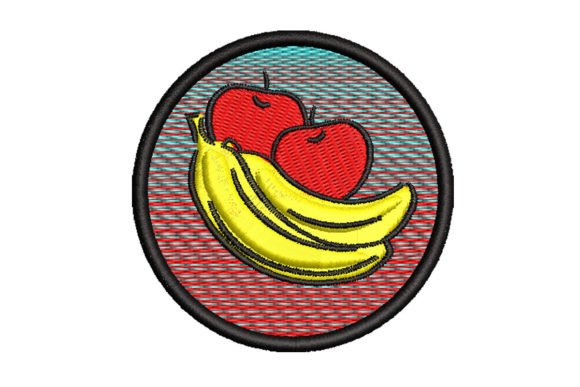
- Embroidered patch: Highly effective as a sew-on or iron-on option. Its self-contained composition means no awkward cutouts or stray elements—ideal for attaching to denim jackets, market bags, or kids’ backpacks.
- Fabric pouch & pillow cover: Strong secondary placements. At 3–4 inches wide, Fruits anchors the surface without competing with texture or pattern. Especially effective on neutral solids or subtle tonal prints.
What Holds Back Its Versatility (And How to Work Around It)
Fruits isn’t universally forgiving—and that’s okay. As a working embroidery designer, I flag these practical limits upfront:
- Dense stitch areas: If the file includes layered fruit textures (e.g., stippled citrus rind or berry clusters), expect higher stitch density. Test on scrap first—especially for dark fabrics where thread buildup can look muddy.
- Small details on curved surfaces: Skip placing Fruits on the front panel of structured caps unless you’ve confirmed hoop compatibility and stabilizer support. Curves distort fine outlines.
- Low-contrast thread colors: The description says “add a touch of personality”—so don’t default to beige-on-cream. Choose thread colors that pop: kelly green stems against navy, coral peels on charcoal, or golden yellow against deep olive.
- Scale sensitivity: While Fruits works well at 3–5 inches, shrinking below 2 inches risks losing legibility—especially if stems, leaves, or small fruit contours are intricate. Not ideal for tiny keychain pouches unless simplified.
Photography, Listings, and Online Conversion
For Etsy sellers and digital embroidery file shops, Fruits is a strong performer. Its clean silhouette photographs crisply—even on smartphone cameras—and integrates seamlessly into printable mockups. Use flat-lay shots with real produce nearby (a lemon, a bunch of grapes) to reinforce the Food category without looking staged. Buyers respond to authenticity, and Fruits feels handmade, not mass-produced.
That said: avoid overloading your listing with too many variations at launch. Start with three hero mockups—Fruits on a linen tote, a cotton apron, and a set of tea towels—and let customer feedback guide expansion. This keeps your design assets focused and your production batch-friendly.
Booth Impact & Buyer Engagement
At craft fairs, attention spans are short and visual hierarchy is everything. Fruits cuts through visual noise because it’s emotionally warm, thematically clear, and stylistically cohesive across product types. I’ve watched customers pick up a plain canvas tote, see Fruits stitched just right on the front, and immediately ask, “Is this available in other colors?” That’s the engagement signal every handmade product needs.
It also strengthens brand consistency—if your shop leans into fresh, seasonal, or garden-to-table aesthetics, Fruits becomes part of a recognizable visual language. Pair it with herb-themed designs or simple vegetable motifs later, and you’ve built a mini-collection that feels intentional, not random.
Production Notes Every Embroidery Designer Should Run Through
Before cutting your first production run—or uploading to your Etsy shop—run this checklist:
- Test the embroidery file on scrap fabric matching your intended product (e.g., canvas for totes, terry for towels).
- Check thread contrast: hold swatches under both natural and booth lighting.
- Review spacing and margins—especially if stitching near seams or hems.
- Confirm hoop size compatibility with your machine and product type (e.g., cap frames vs. standard hoops).
- Inspect stitch density: dense fills may require tear-away + cut-away stabilizer combo on lightweight fabrics.
- Use the right stabilizer—no exceptions. Even “quick and easy” designs fail without proper backing on textured or stretchy materials.
- Create at least one real finished product—not just a mockup. See how Fruits drapes, wears, and holds up to handling.
- Compare fabric colors side-by-side: a design that pops on ivory may disappear on ecru.
- Verify commercial licensing terms before selling finished products. Since this is labeled a machine embroidery design, confirm whether resale rights are included—many digital embroidery file sellers restrict commercial use unless explicitly stated.
Final Verdict: A Reliable, Repeatable Craft Fair Staple
Fruits won’t win design awards for avant-garde innovation—but it’s exactly the kind of dependable, joyful, and versatile embroidery file that moves units at weekend markets and converts browsers into repeat buyers online. It balances personality with polish, simplicity with character, and handmade appeal with professional execution.
For embroidery business owners building scalable product lines, Fruits is low-risk, high-return. It’s easy to explain (“fresh, fun fruit art”), fast to stitch, and flexible enough to anchor multiple categories—from kitchen textiles to wearable accessories. Just remember: its strength lies in clarity, contrast, and context. Let it shine where it belongs—in the hands of customers who want something cheerful, well-made, and unmistakably human.