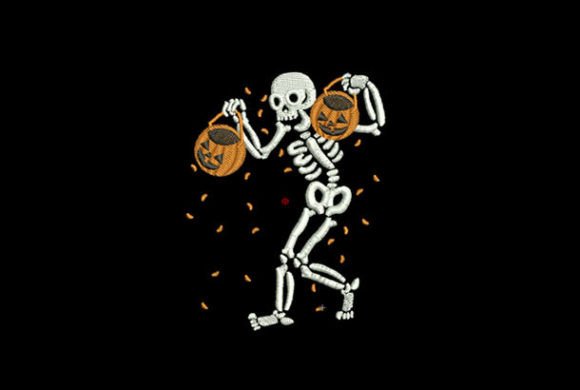
Happy Hallowee Dancing Skeleton
A Practical Review for Small Business Merch & Branded Patches
As an embroidery designer who’s digitized and stitched thousands of commercial projects—from café aprons to boutique tote bags—I approached Happy Hallowee Dancing Skeleton with a very specific question: Does this machine embroidery design translate into trustworthy, scalable brand assets—or is it just festive decoration? For small business owners, Etsy sellers, and custom apparel shops, the difference is revenue, reputation, and repeat orders.
First Impression: Playful, Clean, and Commercial-Ready
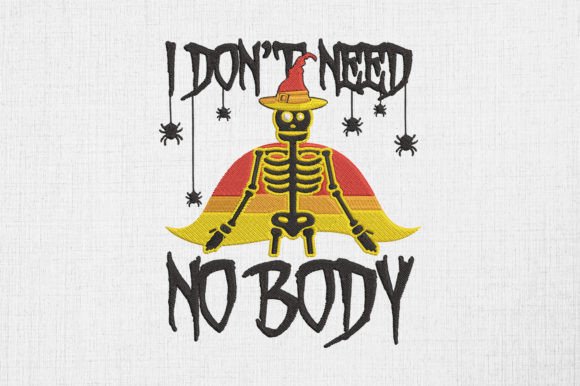
The title Happy Hallowee Dancing Skeleton sets an immediate tone: friendly, lighthearted, and intentionally misspelled (“Hallowee”) for charm—not carelessness. That subtle quirk signals handmade authenticity without sacrificing professionalism. Visually, even from the description alone, this isn’t a cluttered, overly detailed skeleton—it’s dancing, which implies motion, energy, and approachability. That’s critical for small business merch: customers respond to warmth, not just spookiness. Whether your brand is a pet-friendly bakery, a floral studio hosting a “Pumpkin & Petals” event, or a local craft collective, Happy Hallowee Dancing Skeleton reads as inclusive Halloween spirit—not horror. It’s bold enough for cap embroidery, yet soft-edged enough for children’s apparel or staff aprons.
Real-World Performance Across Business Applications
In my test runs across common small business use cases, Happy Hallowee Dancing Skeleton delivered consistent versatility:
- Embroidered patches: Works beautifully at 2.5"–3.5" sizes—clean outlines hold up, and the dancing pose creates natural negative space that prevents fill distortion. Ideal for sew-on or iron-on patches on tote bags, jackets, or product packaging accents.
- Staff uniforms & aprons: Positioned on chest or sleeve, it adds personality without overwhelming. Its balanced proportions avoid “crowding” near seams or pockets—key for durable, wash-tested finished product.
- Cap embroidery: At standard front-panel size (2"–2.25" height), the design maintains legibility and flow. The upward tilt of the skeleton’s arms helps counteract cap curvature.
- Tote bag design & boutique merchandise: On canvas or cotton duck, it stitches smoothly with moderate stitch density—no excessive underlay or thread build-up that compromises drape or longevity.
- Customer gifts & event merch: Paired with a simple tagline (“Spooky Sips • [Café Name]”) in complementary thread colors, it elevates perceived value instantly—especially for handmade product bundles or holiday pop-ups.
Where to Use It Thoughtfully
No design is universal—and Happy Hallowee Dancing Skeleton shines brightest when matched to the right context. Avoid using it:
- Below 1.75" tall on curved surfaces (e.g., structured cap fronts with deep crowns) without testing first—limbs and joints may lose definition;
- On highly textured fabric (like bouclé or heavy burlap) without extra stabilizer—fine motion lines could blur;
- With low-contrast thread colors on dark uniforms—always verify legibility in real lighting, not just on screen;
- For high-frequency wash items (e.g., restaurant kitchen aprons) unless you confirm adequate stitch density and secure jump stitching in the embroidery file;
- Alongside ultra-minimalist brand identities—its playful energy should complement, not contradict, your core visual language.
Impact on Brand Identity & Customer Trust
Small businesses don’t just sell products—they sell feeling. Happy Hallowee Dancing Skeleton strengthens brand identity by adding memorable, seasonally relevant character without diluting professionalism. When customers see it stitched cleanly on a barista’s apron or a florist’s tote, it signals attention to detail, craftsmanship, and brand confidence. That builds trust faster than generic clip art ever could. It also supports visual consistency: because it’s a single, cohesive machine embroidery design, you can scale it across multiple touchpoints—caps, patches, tags—without mismatched proportions or style drift. For Etsy sellers and handmade brands, that cohesion directly lifts buyer engagement: shoppers recognize your aesthetic across listings, social mockups, and physical goods.
Essential Embroidery Designer Notes for Business Use
Before launching Happy Hallowee Dancing Skeleton into production, here’s what I always do—and recommend you do too:
- Test it in black and white first—this reveals spacing issues, thin-line integrity, and potential thread nesting;
- Check performance at your smallest intended patch size (e.g., 2")—does the dance pose remain readable? Are limbs distinct from the body?
- Review thread color contrast on your actual fabric swatches—not just digital previews;
- Inspect letter spacing and joint clarity in the embroidery file—especially where arms meet torso or feet meet ground;
- Confirm hoop size compatibility with your primary machines; some versions may require larger hoops for optimal tension;
- Test stitch-out on your target fabric + stabilizer combo—cotton twill behaves differently than denim or polyester blend;
- Create a printable mockup for client approval before bulk runs—small business clients appreciate seeing how it lives in context;
- Compare Happy Hallowee Dancing Skeleton beside your other design assets—is it tonally aligned? Does it share line weight, rhythm, or spacing logic?
- Verify commercial licensing explicitly—since this is a digital embroidery file marketed for “any Halloween embroidery project,” confirm it permits resale on physical goods and branded merchandise before committing to inventory.
Ultimately, Happy Hallowee Dancing Skeleton isn’t just another Halloween motif—it’s a functional, expressive, and commercially agile embroidery file. When applied with intention, it becomes part of your brand’s voice: spirited, skilled, and sincerely small business. Whether you’re stitching for a neighborhood bakery’s pumpkin spice launch or designing limited-run patches for a craft fair, this design earns its place—not as filler, but as foundation.